
UTIQ’s Detailed Reporting
For advertisers and publishers seeking deeper insights into user engagement and audience dynamics, UTIQ provides an advanced reporting solution that goes beyond Equativ’s standard analytics. This detailed report includes UTIQ-specific metrics such as Unique UTIQ Users vs. Impressions and frequency dispersion analysis, offering a precise and privacy-compliant view of audience reach in a cookieless environment. By leveraging these insights, advertisers can optimize their targeting strategies, measure real impact, and improve the efficiency of their campaigns.
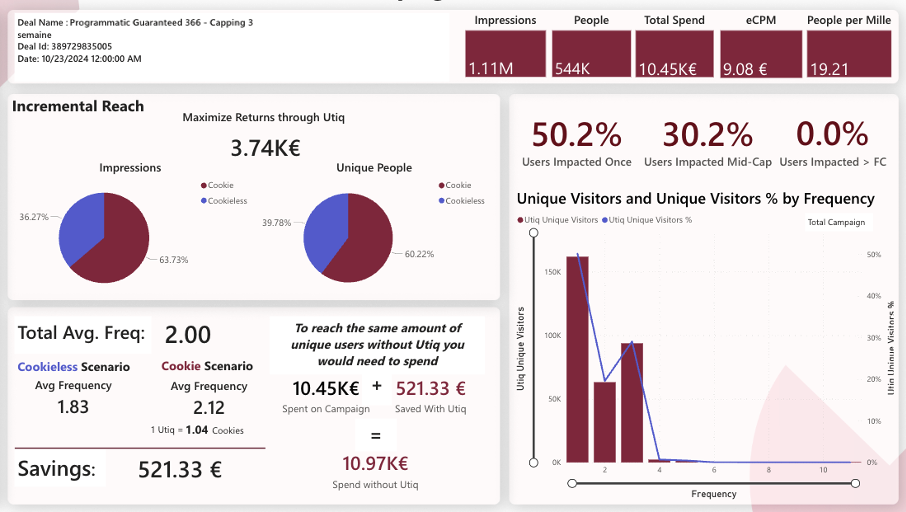
Within this report, you can access key performance indicators such as total impressions, real users impacted (distinct from cookies), total spend, and cost per 1,000 impressions (CPM). Additionally, UTIQ provides a breakdown of users reached beyond cookies, showing how many impressions were delivered in a cookieless environment, ensuring visibility into campaign effectiveness across all addressable audiences.
Savings
One of the most valuable aspects of UTIQ’s detailed reporting is its cookie overlap savings calculation. Thanks to UTIQ’s ability to measure cookie overlap, we eliminate duplicated cookies, ensuring that campaign impressions are not wasted. This means advertisers achieve greater cost efficiency by reaching real, unique users instead of repeatedly targeting the same person under different cookies.
Remember that only one of the two major benefits of using UTIQ can be measured: cookie deduplication. To measure the other key benefit—true person-based frequency capping and limitation we recommend following this method.
Incremental reach
Furthermore, the report calculates Incremental Reach, highlighting what portion of your investment successfully targeted the cookieless audience, a segment that would otherwise be inaccessible through traditional methods.
Frequency impact distribution
Lastly, UTIQ provides a histogram of frequency distribution, a crucial metric for campaign optimization. Unlike other providers that rely on probabilistic models, UTIQ delivers fully deterministic frequency measurement, ensuring advertisers have an accurate and transparent view of how their audience is being exposed to their ads. This granular level of detail allows brands to refine their budget allocation, optimize exposure levels, and improve overall ad performance in a way that was previously unattainable in the cookieless landscape.
Frequency Contact Classes
UTIQ's reporting breaks down audience exposure into three distinct contact classes, giving advertisers a clear picture of how their frequency strategy is performing.
-
Users Impacted Once represents the share of unique users who were exposed to the ad a single time. This is a key indicator of net new reach users who entered the campaign funnel but were not re-engaged. A high percentage here typically signals broad reach with room to increase exposure if the campaign objective requires deeper engagement.
-
Users Impacted Mid-Cap captures users who were exposed more than once but stayed within the defined frequency cap. These are the users where the campaign is working as designed building awareness or consideration through repeated, controlled exposure without oversaturating the audience.
-
Finally, Users Impacted > FC shows the share of users who exceeded the frequency cap. In this campaign, the result confirms that the capping strategy (3 impressions per week) was enforced with full precision no user was over-exposed beyond the intended limit. This is only possible because UTIQ operates on a deterministic, person-based identity rather than relying on cookie-based proxies, which are inherently prone to frequency miscounting and over-delivery.
People per Mille (PPM):
Standard CPM measures how much it costs to deliver 1,000 impressions, which in practice means 1,000 cookies, not 1,000 people. Because the same user is typically fragmented across multiple cookies, classic CPM systematically overstates reach and understates true cost. People per Mille (PPM) corrects this distortion: it tells you how much investment is required to reach 1,000 unique, real persons, as identified deterministically by UTIQ. It is the cleanest like-for-like benchmark for comparing campaigns, plans, or partners on a person basis rather than a cookie basis, and the most reliable indicator of real audience cost in a cookieless environment.
Maximize Returns through UTIQ
This figure quantifies the portion of your campaign investment that, thanks to UTIQ, was activated in a cookieless environment, i.e. against an audience that would otherwise be unreachable through traditional targeting. It is calculated by isolating the spend delivered to users identified via UTIQ in browsers and contexts where third-party cookies are unavailable (the "greenfield" audience). In practical terms, it tells you how much of your budget translated into genuinely incremental reach, instead of competing for the same cookied users already saturated by every other buyer in the market. The higher the value, the more your investment is working in inventory that other identity solutions simply cannot address.
Wasted Impressions and Wasted Spend
Wasted Impressions are the impressions delivered to a user after the optimal exposure threshold (the frequency cap) has already been reached. Every impression beyond that point adds no incremental brand or performance value: the user has already been impacted the desired number of times, so any additional contact is, by definition, oversaturation. Wasted Spend is the monetary equivalent: the share of campaign budget consumed by those over-cap impressions. Because UTIQ identifies users deterministically across cookies, sessions, and environments, it can detect over-cap delivery that cookie-based systems are structurally unable to see. Quantifying both metrics is what powers the savings calculation in this report, and what allows advertisers to turn frequency discipline into concrete budget recovery.